As mudanças implementadas na Copa do Mundo prejudicaram a última rodada da fase de grupos?
Com oito equipes já sem nada em jogo, o nível de incerteza na fase de grupos da Copa do Mundo diminuiu? E as preocupações com a integridade da competição são justificadas?

The group stage of the 2026 World Cup always felt as though it might lack jeopardy.
After all, with 32 of 48 teams advancing to the knockout rounds it is more difficult to be eliminated than to qualify.
But the impact of two key changes are perhaps only now being realised by fans as the second round of matches comes to an end.
They are the first ever World Cup using head-to-head records instead of goal difference as the primary tiebreaker for countries level on points.
And the second is this World Cup will feature a third-placed table for the first time since 1994 as teams vie for the eight remaining slots.
Head-to-head means teams can either win a group or be eliminated after two games.
Eight teams already know they have nothing to play for on the third matchday.
For instance, Argentina have six points and cannot be overtaken in Group J because they have beaten the two teams on three points, Austria and Algeria.
Likewise, Jordan on zero points have been eliminated because they have lost to those two teams.
If goal difference were being used first every team would still have something on the line.
Will countries with nothing to play for field weaker teams in their final game as a result?
As for the third-placed table, because there are so many groups it takes five days to complete the final round of matches.
That means, for example, when Scotland play Brazil on Wednesday (23:00 BST) they will have no idea what the cut-off in terms of a points threshold will be to go through in third.
A team playing on Saturday or Sunday will likely know exactly what they require.
All in all, the final week of the group stage is going to feel very different.
- A Golden Boot race for the ages - but who will come out on top?
- What are Clarke's big calls for Brazil? And who would you pick?
- The World Cup stars being targeted by Premier League clubs
Fifa follows Uefa with head-to-head - but this seems different
Using head to head as the first tiebreaker is nothing new. Uefa favours it in all its competitions.
The theory behind it is how it separates teams on the result of the match between them, filtering out potentially big scorelines from other matches which can skew goal difference.
Although half the size in terms of the number of teams competing, since 2016, the Euros has used the same format as the World Cup with some third-placed teams qualifying.
At Euro 2016, Italy topped the group and Ukraine were knocked out after two games.
At Euro 2020 it happened in one group, creating a dead rubber between Netherlands and North Macedonia.
At Euro 2024, Portugal and Spain topped their groups with Poland eliminated.
Yet more teams have already been either eliminated or made it through to the round of 32 at this World Cup (eight) than in the whole of the three Euros combined (seven).
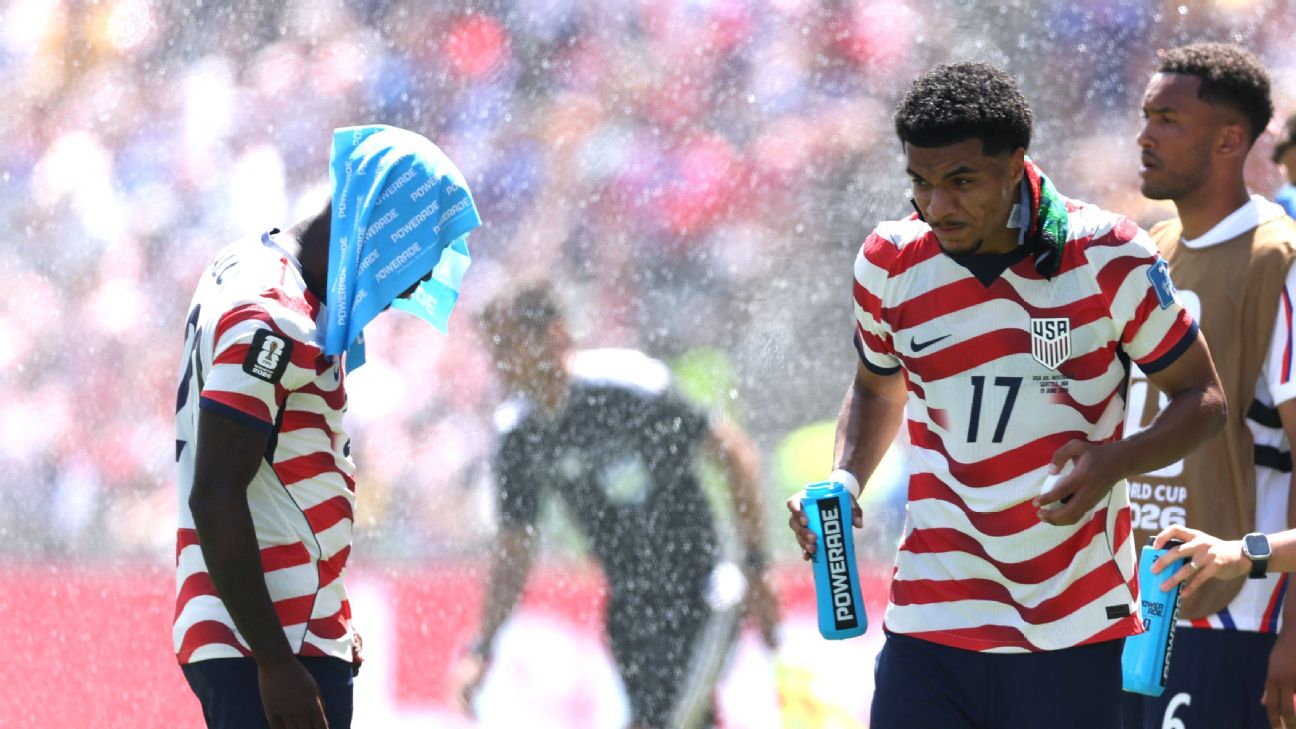
Mexico, USA, Germany and Argentina are locked as group winners.
Haiti, Turkey, Tunisia and Jordan know they will be on the plane home.
USA v Turkey and Argentina v Jordan are dead rubbers, fixtures between group winners and eliminated teams.
More could follow on Tuesday. England/Ghana and Colombia could seal top spot, while Croatia/Panama and Uzbekistan might go out.
At the 2022 World Cup, only Canada and Qatar were eliminated after two rounds.
What would happen if we were to apply head to head and add potential third places to the previous edition of the competition?
France, Brazil and Portugal would have been through as group winners after two matches - a total of five teams impacted.
Why is this? It could indicate a greater gap in quality at the World Cup which has allowed some countries to coast to qualification.
The order of fixtures could be influential too; if the strongest teams play the weakest first that gives them a greater likelihood of accumulating six points.
Why having nothing to play for could matter
Lionel Messi, with five goals in two games, could be rested for the knockout rounds with Argentina having sealed top spot in the group [Getty Images]How will the likes of Argentina and Germany approach their final group games?
It is difficult to predict, but in such an intensive tournament the temptation to rest players will be great.
The group winners have the opportunity to take a refreshed starting XI into the round of 32.
This might be the case for Lionel Messi, who celebrates his 39th birthday on Wednesday.
Messi, however, will be gunning for the Golden Boot having scored five goals already.
We have seen the implications before.
At Euro 2024, Portugal won their first two matches and the group.
For their third fixture against Georgia, Portugal coach Roberto Martinez made eight changes to his starting XI.
Georgia won 2-0, climbed up to third in the group and went through to the round of 16. Hungary were knocked out of the best third-place positions.
We could see this happen at the World Cup, too.
Curacao and Ivory Coast have both lost to a full-strength Germany in Group E.
Like Georgia, Ecuador must win to qualify and might face an under-strength Die Mannschaft on Thursday (21:00 BST).
This feels unfair not only to Curacao and Ivory Coast but also to the teams hoping to take a third-place slot.
Who else could this World Cup be impacted?
In Group A, Czech Republic (one point) will face Mexico at the Estadio Azteca needing a win to qualify.
Morocco (Group C, four points) and Netherlands (Group F, four points) play Haiti and Tunisia respectively. They have enough points to go through but could be aided in a bid to finish top.
- Is VAR being used differently at the World Cup vs the Premier League?
- A Golden Boot race for the ages - but who will come out on top?
- From non-league to the World Cup - the Semenyo story
- What France & Iraq did during 'mentally draining' two-hour weather delay
Why the third-place battle lacks fairness
The fight to be one of the third-place teams at the World Cup is hardly a level-playing field.
If you are playing later in the week you know exactly what result is needed to qualify.
You might be able to play for a draw, or even just limit a defeat for goal difference.
The pitfalls of playing earlier are clear for a team like Scotland.
Scotland are not only playing Brazil on Wednesday, they are fighting with the other 37 sides who could still finish in third place.
Steve Clarke's team are on three points and they are guaranteed to finish no lower than third. They know a win or a draw will be enough.
But sitting on goal difference of zero, a heavy defeat could send them home.
If they do lose, the Scots face an anxious wait, potentially until around 05:00 BST on Sunday morning when Group J completes, before they discover if they are one of the top eight.
The impact for third-placed teams is greater in this truncated tournament, with no rest days before the knockout rounds begin.
Scotland could face Germany in Boston on Monday at 21:30 BST - just 40 hours 30 minutes after the group stage ends and their round of 32 fixture is known.
Then there is impact of two teams playing each other for an advantageous result.
Take the scandal at the 1982 World Cup.
West Germany played Austria in the standalone final group game. A slender win for the Germans would send both teams through at the expense of Algeria. The match finished 1-0 to West Germany.
After this, Fifa changed it so all final fixtures would be played simultaneously. But it does not completely remove the potential.
There is quite the coincidence at this World Cup.
The final game in Group J is Algeria v Austria. Both teams are on three points, and by the time they play on Saturday they will know if a convenient draw sends both safely through to the round of 32.
Two of the teams involved in 1982, but this time Algeria would be the beneficiaries.
In another coincidence, Austria and Ukraine went into the final group game at Euro 2020 with both teams on three points - a draw would have done for both.
Austria won that game 1-0, though Ukraine still went through.
The same situation presents itself in Group D of this tournament - Australia and Paraguay, both on three points, can play for a draw.
A similar incident occurred at Euro 2004 for the top two places, and to this day many Italians believe that Sweden and Denmark engineered the result.
If the match was a draw and the teams scored at least twice, Italy were out because they scored fewer goals in matches between the three sides.
Sweden equalised in the 89th minute. The final score? Sweden 2-2 Denmark.
It is never going to be possible for all potential third-placed teams to play at the same time.
But the system does create a situation whereby being drawn later provides a clear advantage.
Of course, Scotland could just win or draw against Brazil and put qualification to bed.
It is still in their own hands after all.
Yahoo Sports Soccer
Você está vendo uma prévia. Leia a notícia completa na fonte.