Julián Quiñones, Blackness in Mexico and the complexities of national identity
Two years ago, Quiñones was the target of racist chants by fans. Now, hailed as a hero in that same country, he’s challenging expectations of race and identity

On a March night in Guadalajara in 2024, Club América were winning El Clásico Nacional. Julián Quiñones, their star player, had scored and headed toward the sideline. Then a shout at Quiñones, who is Black, rang out from the stands. ¡Puto negro! A racial slur.
Moments later, monkey noises were heard in the stands. The scene was familiar to anyone who follows Mexican soccer. Cell phone videos captured it. Commentators analyzed it the next day. Officials condemned it. Investigations were announced. For a few days, the Mexican game went through its ritual of shock.
Then the season continued. Another match, another transfer rumor, another refereeing controversy. That June, Quiñones moved to Al-Qadsiah in Saudi Arabia, where he would become the league’s top scorer. The incident was lost in the vast archive of soccer’s weekly dramas. Or so it seemed.
Less than two years later, another Mexican stadium produced another uproar. This time it was a celebration.
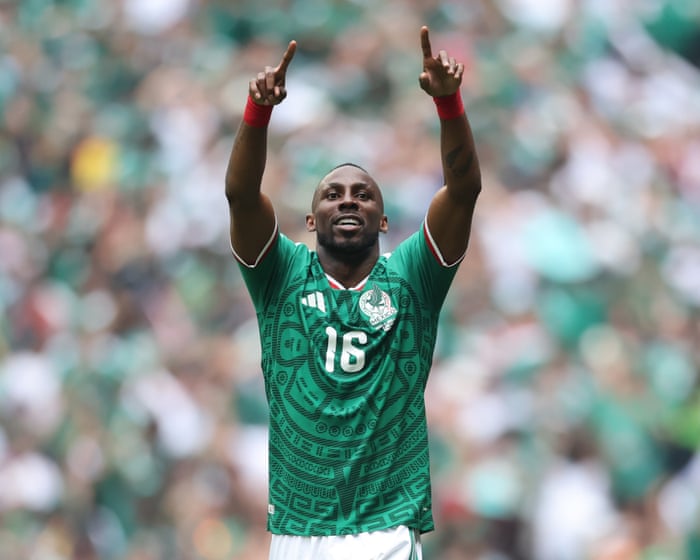
On 11 June, Quiñones scored Mexico’s first goal in the 2026 World Cup, the opening triumph in a tournament played on home soil for the first time in two decades. Tens of thousands rose to their feet. Television commentators chanted his name. Images of the striker draped in the Mexican flag flooded social media. The same culture that had publicly denigrated him hailed him as a national hero.
This week, Quiñones returned to the same stadium in Guadalajara where the racist chant had been heard in 2024. Before Mexico’s second group-stage game against South Korea on Thursday, crowds wearing Mexico jerseys and oversized sombreros gathered outside the hotel housing the national team. When Quiñones appeared they shouted in unison: ¡Quiñones, hermano, ya eres Mexicano! “Quiñones, brother, now you are Mexican.”
It was an embrace for the Mexican national, but still a tentative one. The chant is usually reserved for foreigners who have shown an affinity with Mexico, not for Mexican passport holders like Quiñones.
These moments, so close in time yet distant in spirit, capture all the contradictions of how modern Mexico is grappling with its own national identity.
Karma Frierson, who teaches Black studies at the University of Rochester and has written about Black culture in Mexico, said the discourse around Quiñones’s goal, and the fact that he is Black, was one of surprise. “This surprise speaks to the expectations people still have about what a Mexican person looks like. So, you have this dissonance,” she said. “You know that the player, by virtue of wearing the jersey is of that nationality, but you never imagined that person would look a certain way.”
***
Quiñones, 29, was born in Colombia, arrived in Mexico in 2015 and forged his career in Liga MX. He became a naturalized Mexican citizen in 2023 and was first called up to the national team that same year. His inclusion on the World Cup squad raises a question about race that Mexico has tried to avoid for much of its modern history: who has the right to be Mexican?
The answer is wrapped up in the national soccer program’s future, which increasingly lies beyond Mexico’s borders.
For much of the 20th century, the national team was primarily comprised of players developed within its own territory. Today, however, the pool of Mexican talent extends across a transnational landscape shaped by migration and family networks.
It is possible that the most important soccer recruiting ground for the Mexican federation is no longer a state within Mexico, but rather in California or Texas. A new generation of Mexican-American players is emerging north of the border, including more Black players. Two of the most promising young prospects for Mexico’s program were born in the United States to Mexican mothers and African American fathers. Antonio Leone and Da’vian Kimbrough, both born in California, have represented Mexico’s youth teams.
Other recent stars have come from farther south. In recent years, Giovani and Jonathan dos Santos played on the national team. Their father was the Afro-Brazilian footballer Zizinho; their mother is Mexican. Melvin Brown, who was of Jamaican descent through his paternal grandfather, represented Mexico at the 2002 World Cup.
None of these players fit neatly into the visual stereotype often associated with Mexican nationality.
“Historically, Mexican society doesn’t talk about race,” Frierson said. “The promise of mestizaje was that there is no race because we are all one race.”
The concept of mestizaje – the idea that Mexico emerged from the fusion of Indigenous and European peoples – became one of the founding myths of the modern Mexican state. After the Mexican revolution, it offered an appealing narrative for a fragmented nation. Instead of emphasizing difference, it emphasized mixing. Instead of multiple peoples, it envisioned a single people.
Versions of this ideology emerged throughout Latin America, and served as a powerful contrast to the racial order of the United States. While the US openly grappled with segregation and racial classification, many Latin American countries embraced the notion that mixing itself had dissolved such distinctions.
The promise was seductive. The reality proved to be more complex.
Discrimination and racism against Black people in Mexico are still prevalent but often dismissed. When South Africa hosted the World Cup in 2010, Mexico’s largest broadcaster Televisa featured characters in blackface and afro wigs wearing animal skins and wielding spears. In 2018, on major broadcaster TV Azteca, reporter Carlos Guerrero appeared in blackface during a broadcast of a Liga MX game. The networks received criticism but many people brushed the incidents off as jokes.
Black players in Liga MX – Colombian striker Darwin Quintero, who played for América, and Panamanian defender Felipe Baloy, who played for Santos Laguna – have accused rival teams of racist insults. In 2021, Ecuadorian Félix Torres, a defender for Santos Laguna, left the field in tears after reporting alleged racist insults from Germán Berterame, then a player for Atlético de San Luis. While the Mexican Football Federation investigated those incidents, officials said they could not be corroborated and no disciplinary action was taken.
Quiñones himself mostly shrugged off the 2024 racist incident in Guadalajara. In an Instagram statement at the time, he spoke out against online harassment of his daughters – “you can say whatever you want to me, but don’t mess with my daughters” – and said he was “mentally strong enough to handle any kind of insult, especially when it’s about my skin color, which is the most frequent type of message I receive”.
***
Having a Black player excel at a home World Cup may help bring race to the forefront of Mexican culture in a way that it hasn’t before, Frierson said.
At the same time, Mexican players who travel to the US to play in Major League Soccer are also bringing new perspectives back home. Jonathan dos Santos, in a 2020 interview when he was playing for LA Galaxy, said he felt comfortable in the US because he didn’t receive racist taunts.
“It’s truly sad to hear the insults, the racism. I’ll never understand it,” he said at the time. (He said he also experienced racism in Spain, where he played for Barcelona and Villarreal.) “I think many countries have to learn from the United States regarding the respect shown to athletes.”
Opening up a discussion about race in the country’s national sport, could lead to a broader exploration of Mexico’s own history, which includes roots in Africa. During the colonial period, hundreds of thousands of enslaved Africans were brought to New Spain. Their descendants built communities throughout the territory, especially in Veracruz and along the Costa Chica of Guerrero and Oaxaca. They participated in the formation of Mexican society from its very beginnings. Vicente Guerrero and José María Morelos were both heroes of Mexican independence with Afro-Mexican roots, though that heritage is not often mentioned.
“Blackness is incorporated into the very fabric of the nation,” Frierson said.
Seen from this perspective, it’s not just that Mexican soccer today is becoming more diverse. It’s that race in Mexico is becoming more visible.
Soccer, at times, can be a national mirror. A national team represents not just a country, but an idea of the country. The World Cup is one of the few remaining spaces where nations are publicly showcased. Every starting lineup announcement, every anthem, every goal becomes a debate – sometimes conscious, often unconscious – about who belongs.
Mexico is changing. Digital nomads from Europe and the US are setting up shop in Mexico City, opening trendy coffee shops and stores that resemble those in other international capitals. People from Haiti, Cuba and South America have settled in the country at unprecedented levels, some discouraged from migrating to the US. And some Mexicans who had been living in the US for decades are now returning home with their American families, either voluntarily or after deportations. The Mexican national team is beginning to show a bit of that diversity: the World Cup squad includes a player born in Spain, Álvaro Fidalgo; another born in Alaska, Obed Vargas; one born in Argentina, Santiago Giménez; and Quiñones, who was born in Colombia.
Quiñones is challenging the expectations many still hold about what a Mexican is supposed to look like. Mexican diversity has always existed, but soccer possesses a unique ability to bring that reality to light.
A player scores a goal. The crowd rises. Cameras search for a face. And, for an instant, a nation contemplates itself. Not necessarily as it imagined itself to be, but as it has been all along.
Yahoo Sports Soccer
Bạn đang xem bản tóm tắt. Đọc toàn bộ bài viết tại nguồn.